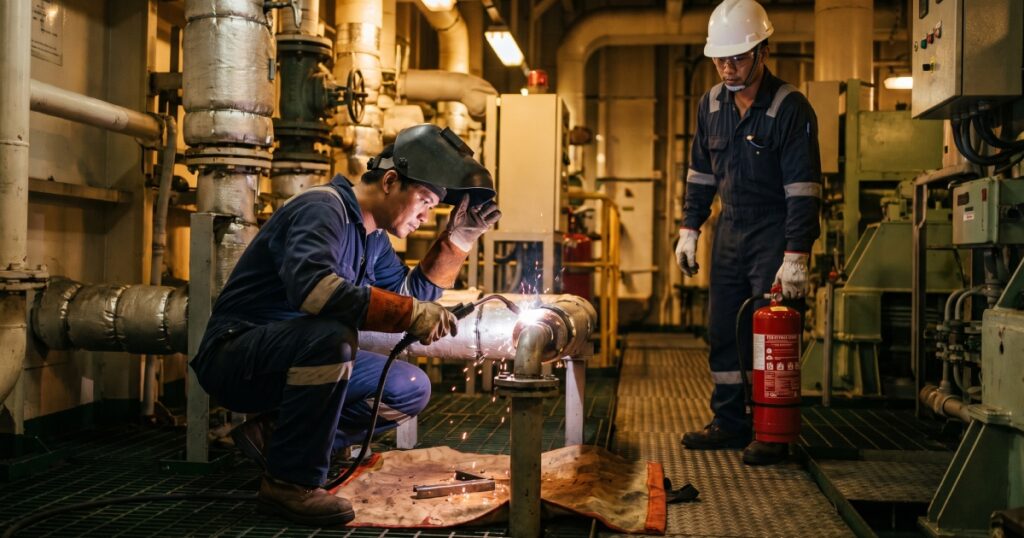
A welder needs twenty minutes on a pipe bracket in the engine room workshop, and the detector directly above the work will alarm within seconds of the first arc. The chief engineer isolates the zone at the panel, the job goes ahead, and everyone moves on to the next task. Whether that sequence was compliant depends almost entirely on what happened in the hour afterwards.
Isolating part of a fixed fire detection system is permitted and expressly provided for in the Fire Safety Systems Code, the FSS Code being the technical rulebook that SOLAS Chapter II-2 points to for how detection systems must be built and operated. What the Code attaches to that permission is a short set of conditions which crews routinely satisfy only in part.
May Detectors Ever Be Switched Off?
Yes, for defined operations in defined spaces. Chapter 9 of the FSS Code requires that a fixed fire detection and fire alarm system with manually operated call points be capable of immediate operation at all times, then names two examples where particular spaces may be disconnected: workshops during hot work, and ro-ro spaces during on and off-loading. The same paragraph closes the door on anything wider by requiring that detectors in all other spaces remain operational, which makes an isolation a space-by-space decision and never a system-wide one.
What Has To Happen While A Zone Is Isolated?
The space has to be manned or provided with a fire patrol for as long as the detectors serving it are disconnected. That single requirement is where most isolations quietly fall short, because a permit will often name a fire watch for the duration of the hot work itself while the detection stays isolated through the cooling period that follows.
Cooling is the part that catches vessels out. Smouldering in lagging or in accumulated oil residue can develop for a considerable period after the torch is put down, and that is precisely the window in which the space has neither working detection nor a person standing in it. Treating the fire watch as running until the zone returns to surveillance, instead of until the welding stops, closes the gap at no cost.
Isolation is normally carried out at the control panel, so the granularity the panel offers determines how surgical the decision can be. Our Singapore-supplied Tyco fire alarm control panel range covers marine platforms with zone and device level isolation, which allows a single detector to be taken out of surveillance where a coarser system would force a whole section offline.
Why Must The System Restore Itself Automatically?
Because human memory is the identified failure mode. The Code requires that the means for disconnecting detectors be designed to automatically restore the system to normal surveillance after a predetermined time appropriate to the operation in question, which turns a forgotten isolation into a temporary condition instead of a permanent one.
Setting that predetermined time deserves thought at commissioning. A period long enough to cover a full working shift will keep a zone out of surveillance across a watch handover, while a period of an hour or two forces a deliberate decision to re-isolate and creates an audit trail of that decision in the panel event log. The figure is a matter for the operation concerned and the flag or class surveyor’s expectations, so it belongs in the safety management system rather than in an installer’s default settings.
What Changed For Ro-Ro Spaces In January 2026?
Amendments introduced by IMO resolution MSC.555(108) took effect on 1 January 2026 and split the question by sensing element. On ro-ro passenger ships constructed on or after that date, the smoke detector function in special category and ro-ro spaces may be disconnected during loading and unloading of vehicles, while disconnection of the heat detection function or of manual call points is not permitted at all. The same amendments require a consistent alarm presentation scheme and an interface that lets crew suppress alarms while keeping any alarm with an ongoing trigger condition clearly visible. Those insertions also renumbered the later paragraphs of section 2.5.1, so a citation taken from a pre-2026 print of the Code will now point at the wrong provision.
How Should An Isolation Be Recorded?
Three records should agree with each other: the permit to work, the panel event log, and the handover notes passed to the next watch. An isolation that appears in only one of them is the one that gets missed.
The weekly panel check is the natural backstop. IMO maintenance guidance calls for verifying that all fire detection and fire alarm control panel indicators are functional by operating the lamp or indicator test switch, as set out in the IMO guidance on maintenance of fire protection systems, and a crew member standing at the fascia for that check is well placed to notice a zone still showing as isolated.
Where Do Isolations Go Wrong?
Four patterns account for most of the findings raised at inspection. The first is an isolation that survives a watch handover because it was never written down. The second is a whole loop taken offline when a single device would have done, usually because the panel groups devices coarsely.
The third is a fire watch posted for the hot work and stood down before surveillance returns. The fourth is an isolation applied to heat detection or to manual call points in a ro-ro space, which the 2026 amendments now rule out explicitly.
That second pattern is a design question as much as an operational one, and the choice between addressable vs conventional fire alarms largely settles how much of a vessel has to lose surveillance so that one workshop can take a welding job.
Keep Isolation Deliberate And Short
An isolation that is written down, watched, time-limited and self-restoring is a routine operational step. One that is none of those becomes a finding, and occasionally something worse. Atlas Technologies Corporation supplies and services marine fire and gas safety equipment from Singapore for owners and managers across Southeast Asia, the Aegean and the Eastern Mediterranean, and we are glad to look at what a vessel’s installed panel can and cannot isolate. Speak to our team about your isolation arrangements and we will help you tighten them up.