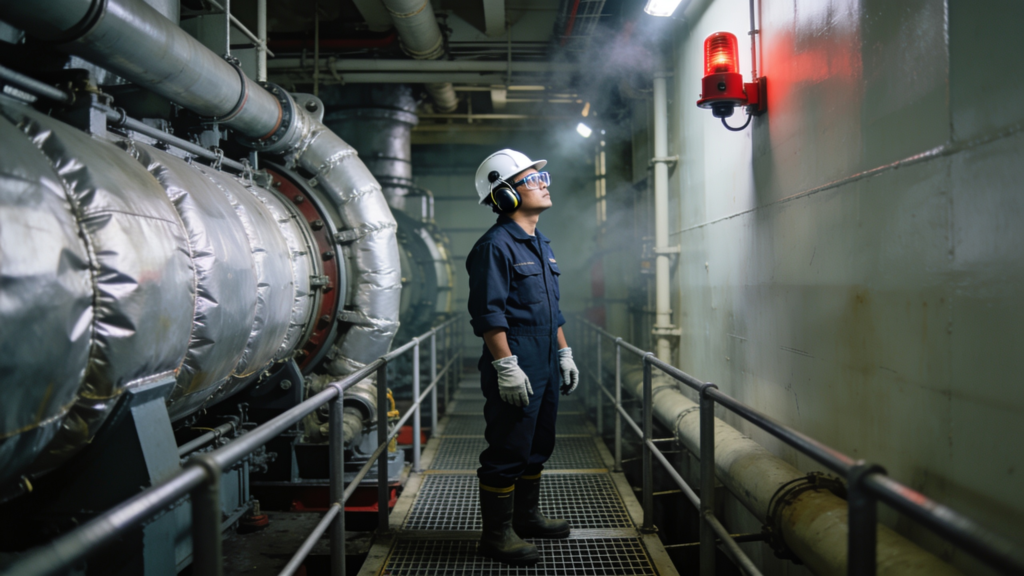
The twenty seconds between a release cabinet door opening and carbon dioxide entering a machinery space is the whole of the protection available to anyone still inside it. Whether that warning reaches them was decided when the signalling devices were specified, often years earlier.
The requirement is short, precise and frequently under-read. It sits in Chapter 5 of the FSS Code and not in the detection chapter, which is part of why it tends to be treated as somebody else’s scope.
What Does The FSS Code Require Of A Pre-Discharge Alarm?
Means shall be provided for automatically giving audible and visual warning of the release of fire-extinguishing medium into spaces in which personnel normally work or to which they have access. The provision extends to ro-ro spaces, container holds equipped with integral reefer containers, and spaces accessible by doors or hatches.
Three characteristics are specified. The alarm is located so as to be audible throughout the protected space with all machinery operating. It is automatically activated, for example by the opening of the release cabinet door. And it operates for the length of time needed to evacuate the space, but in no case less than 20 seconds before the medium is released. Resolution MSC.206(81) introduced the current wording, which has applied since 1 July 2010.
Conventional cargo spaces and small spaces such as compressor rooms and paint lockers with only a local release need not be provided with such an alarm.
Why Does The Alarm Have To Be Distinguishable?
A crew member in a machinery space hears several alarms in a normal working week, and a warning that sounds like any of them will be read as a fault first and acted on second. The Code requires the pre-discharge alarm to be distinguishable from other alarms, achieved through adjustment of sound pressure or sound patterns.
Pairing it with a dedicated visual device is the practical answer wherever hearing protection is in use. A federal signal sounder and beacon combination of matching ingress protection, supplied from Singapore for vessels working the Strait of Malacca, keeps the warning clearly separate from the marine fire detection alarms already installed in the same compartment.
Where the protected space is a hazardous area, device selection follows the same logic as offshore explosion-proof beacon lights, since the equipment has to survive the atmosphere it is warning about.
Crew familiarisation carries as much weight as the hardware. A warning that is technically distinct but has never been heard during a drill will still be interpreted as something else on the day, so the pre-discharge alarm belongs in the drill programme and not only in the service report.
What Else Does Chapter 5 Say About Preventing A Release?
Two adjacent provisions bear on the same design. The pipes conveying the medium must be provided with control valves marked so as to indicate clearly the spaces to which the pipes are led, together with suitable provisions to prevent inadvertent release of the medium into the space. The controls must be readily accessible, simple to operate, grouped together in as few locations as possible, and positioned where they are not likely to be cut off by a fire in a protected space.
Automatic release of the medium is not permitted, except as permitted by the Administration. A fixed gas system is therefore a deliberate human action wrapped in a warning, and the warning is the only part of that sequence the crew experiences before the gas arrives.
Marking the valves clearly is the least glamorous item on that list and the one most often degraded, since paint and time remove the very labelling the Code asks for. A valve that no longer identifies the space it serves turns a deliberate action into a guess.
When Are The Alarms And The Time Delay Tested?
Less often than most engineers assume. The current guidance is MSC.1/Circ.1318/Rev.1, the revised guidelines for the maintenance and inspections of fixed carbon dioxide fire-extinguishing systems, dated 25 May 2021. It requires that all controls and warning devices function normally, and that the time delay, where fitted, prevents the discharge of gas for the required time period.
That test falls in the biennial regime for passenger ships and at renewal survey for cargo ships, and it is to be performed by trained service technicians. The service chart in the guidelines itemises it as a time delay device test for correct setting and a warning alarm test, alongside a fan stop test where one is fitted.
The annual regime is lighter and sits closer to the crew, covering the boundaries of the protected space for openings that cannot be closed, the storage containers, the piping and nozzles, the manifold and flexible discharge hoses, and the entrance doors, warning signs and remote release controls. A vessel whose annual inspection never looks at the warning signs or the release controls is leaving the most human part of the system unchecked.
What Is Changing At IMO?
Accidental release is under active review. The IMO Sub-Committee on Ship Systems and Equipment agreed clarifications at its twelfth session in March 2026 aimed at the risk of accidental releases of carbon dioxide into machinery spaces and cylinder rooms, including a requirement for a simulated functional test whenever the system is modified or components are changed, and a definition of anniversary dates as dates of manufacture, according to DNV’s report on the session.
Those draft amendments went forward to the Maritime Safety Committee for approval in December 2026, with implementation expected twelve months afterwards, so the operative instrument for now remains the 2021 guidelines. Singapore-registered ships also work to MPA Shipping Circular No. 13 of 2021, under which high-pressure cylinders are hydrostatically tested at or before their 20th and 30th year anniversary and every 10th year anniversary thereafter.
Get The Warning Right Before The Next Service
The devices that carry this warning are inexpensive relative to what they protect, and they are among the easiest items on a vessel to specify correctly. Atlas Technologies Corporation is a Singapore-based supplier and an authorised distributor for Tyco, Federal Signal and Solo, supplying signalling devices, detection equipment and technical support to fleet owners, superintendents and procurement teams across Singapore, Malaysia, Indonesia, Greece and Turkey. Talk to our team about the warning arrangements on your protected spaces before the next scheduled service falls due.