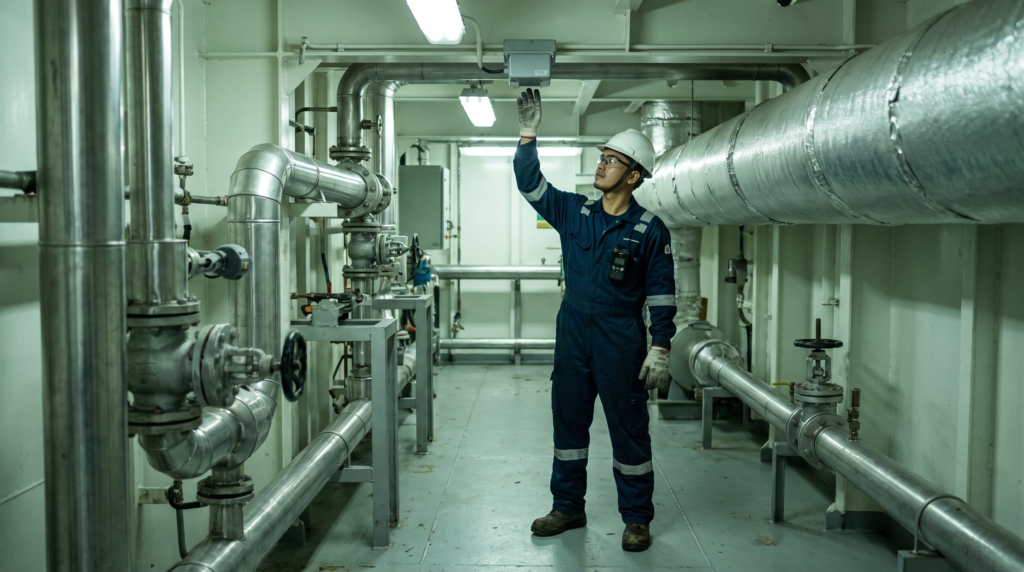
A methanol-fuelled engine room presents a problem no conventional detection layout was designed for. Methanol burns with a pale, nearly invisible flame producing very little smoke, so an optical smoke detector can sit directly above a developing pool fire and report nothing at all. Ammonia inverts the problem, since the hazard reaching the crew first is toxic rather than flammable.
Fleets ordering dual-fuel tonnage are therefore specifying detection against a moving regulatory target. The framework exists, but it is spread across a mandatory code and a growing set of interim guidelines, and each fuel shifts the technical basis of the design.
What Does The IGF Code Require?
The IGF Code, adopted as IMO resolution MSC.391(95), is the mandatory instrument for ships using gases or other low-flashpoint fuels. Its Chapter 11 covers fire safety, with the stated goal of providing for fire protection, detection and extinction measures, while gas detection requirements sit in the control, monitoring and safety systems chapter. One functional requirement puts the obligation plainly: fixed gas detection suitable for all spaces and areas concerned shall be arranged. The Code also ties detection to action instead of annunciation alone, requiring a fixed gas detection system arranged to automatically shut down the gas supply and to disconnect all electrical equipment or installations not of a certified safe type.
Why Do Smoke Detectors Fall Short On These Fuels?
Because the combustion products they rely on are largely absent. The IMO interim guidelines for methyl and ethyl alcohol fuels address this directly, stating that smoke detectors should be used in combination with detectors which can more effectively detect alcohol fires. The draft interim guidelines for hydrogen make the same point in stronger terms, noting that smoke detectors alone should not be considered sufficient for rapid detection of a fire. That pushes flame detection into spaces where a conventional vessel would have relied on smoke and heat, changing the sensing technology as well as the layout. A single-band infrared flame detector keyed to the carbon dioxide emission of a hydrocarbon fire has little to work with on methanol and nothing at all on hydrogen, so ultraviolet and multi-spectrum arrangements move from optional to necessary. The contrast with a conventional installation is stark, and the assumptions behind smart detection for engine rooms largely stop applying once the fuel changes.
As a Singapore supplier of marine fire and gas safety equipment to the marine, offshore and oil and gas sectors, we see these two systems specified separately far more often than they should be.
How Are Gas Alarm Set Points Chosen?
For flammable gases, set points are expressed as a percentage of the lower explosive limit, with alarm and safety system actions at separate thresholds. The widely applied arrangement under the IGF Code puts the audible and visible alarm at 20% of the lower explosive limit and the safety system action at 40%, with higher thresholds used for ventilation ducts and hoods where a leak is expected to be diluted. Operators should confirm the exact sub-paragraph figures against the current published Code, since the numbering has been amended more than once.
The redundancy requirement carries as much weight as the threshold. Automatic shutdown is generally required to depend on two independent detectors reading gas before it acts, so that a single sensor fault cannot trip a propulsion shutdown, with a relaxation available where a self-monitoring detector is fitted. Designing that voting arrangement is where a detection refit either works or generates nuisance shutdowns.
| Fuel | Detection basis | Typical thresholds |
|---|---|---|
| LNG and natural gas | Percentage of lower explosive limit | Alarm at 20% LEL, safety action at 40% LEL |
| Methanol and ethanol | Percentage of lower explosive limit, plus flame detection suited to alcohol fires | Alarm at 20% LEL, safety action at 40% LEL at two detectors |
| Ammonia | Parts per million, on a toxicity basis | Alarm at 110 ppm, safety action at 220 ppm |
| Hydrogen | Interim guidelines approved in 2026, thresholds not yet published | Leak detection required in enclosed spaces and on open deck |
Why Is Ammonia Measured In Parts Per Million?
Because it will harm the crew long before it reaches a flammable concentration. The IMO interim guidelines for ammonia as fuel set the audible and visible alarm at 110 parts per million and safety system activation at 220 parts per million, which are toxicity thresholds rather than flammability ones, and they require a sufficient number of detectors to allow for voting based on the size and layout of the space.
That single change of unit has consequences for equipment selection. A catalytic or infrared sensor calibrated for hydrocarbons cannot resolve concentrations in the low hundreds of parts per million, so electrochemical or laser-based sensing becomes the practical route. No IMO instrument mandates a particular sensing technology, and none prohibits hydrocarbon-calibrated detectors outright; the guidelines simply require that detection equipment be designed, installed and tested in accordance with a recognised standard, and the thresholds do the rest. Full detail sits in the interim guidelines for ships using ammonia as fuel.
What Is Coming For Hydrogen?
Interim guidelines for the safety of ships using hydrogen as fuel were approved at the IMO’s Maritime Safety Committee in May 2026, alongside interim guidelines for the use of ammonia cargo as fuel on gas carriers, as reported in DNV’s summary of the session. The draft text carried before approval required that leakage be detectable in enclosed and semi-enclosed spaces and on open deck, and that localised ventilation be provided with gas detection wherever a release is reasonably foreseeable. What it did not contain was any set of alarm percentages, detector counts or express statement on sensor technology. Anyone specifying for a hydrogen project should expect to work from the approved circular text alongside class rules and a project risk assessment, and should avoid treating figures quoted from the LNG regime as transferable.
What Does This Change For A Detection Refit?
More than the detector schedule. A dual-fuel conversion adds hazardous area boundaries, tank connection spaces, fuel preparation rooms and double-walled piping annular spaces, each of which becomes a monitored location with its own alarm and shutdown logic, and the fire detection loop has to coexist with a gas detection system that can stop the engine.
Early coordination between the detection scope and the safety system logic is therefore the most useful thing a technical department can do, because deciding which detectors vote, which trip and which merely annunciate gets expensive to revisit after commissioning.
Specify Early, Before The Yard Does
Alternative fuels are moving faster than the conventions covering them, which puts the burden of judgement on owners and their technical advisers. Atlas Technologies Corporation supplies and services detection equipment from Singapore for fleets and offshore operators across Southeast Asia, the Aegean and the Eastern Mediterranean, and we are glad to work through a fuel-specific detection scope with your project team. Get in touch with us early in the design and we will help you scope it properly.