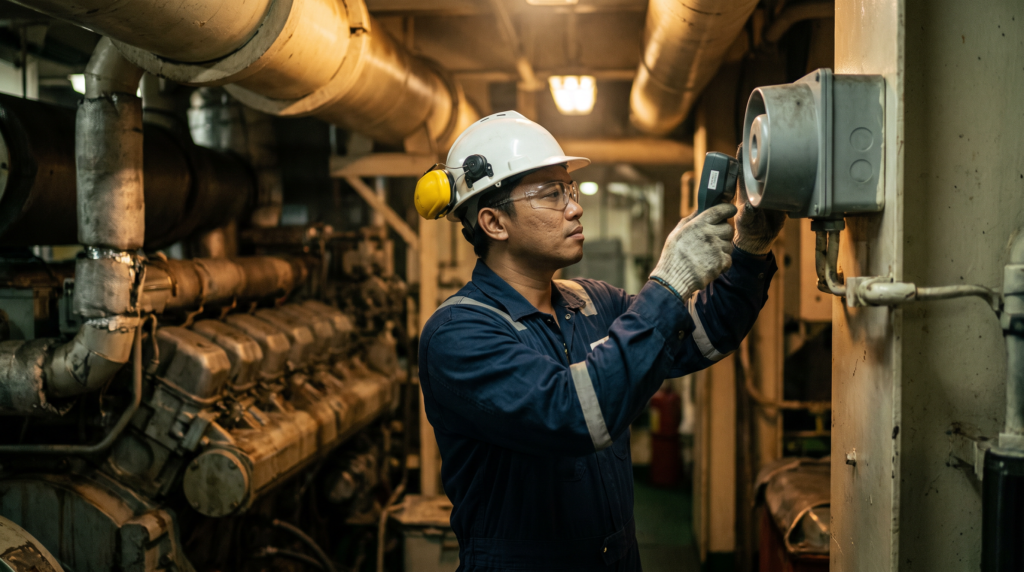
Stand next to a running main engine and a fire alarm sounder can be perfectly compliant on paper and completely inaudible in practice. The crew member who cannot hear it will tell you the system is broken. The datasheet will tell you it produces 100 decibels at one metre. Both can be correct at the same time, and the reason sits in a single clause of the Fire Safety Systems Code.
Getting alarm audibility right is a design calculation more than a product choice. The Code sets an absolute floor and a relative margin, and it is the margin that decides how many sounders a machinery space actually needs.
What Sound Pressure Level Does The Code Require?
Chapter 9 of the FSS Code requires that audible alarm sound pressure levels at the sleeping positions in cabins and one metre from the source be at least 75 dB(A), and at least 10 dB(A) above ambient noise levels existing during normal equipment operation with the ship under way in moderate weather. It caps signals at 120 dB(A) and specifies that the level should be measured in the one-third octave band about the fundamental frequency. The clause opens with the qualifier ‘in general’, so it is a design rule with room for reasoned departure rather than an absolute.
Two details in that sentence are routinely lost. The 75 dB(A) figure applies both at sleeping positions and one metre from the source, which are very different acoustic conditions. And the 120 dB(A) ceiling sits inside the FSS Code itself, not only in the separate Code on Alerts and Indicators where it is often attributed.
A numbering note for anyone citing this in a specification. Amendments in force from 1 January 2026 inserted three new paragraphs earlier in the same section, which pushed the audibility provision from 2.5.1.9 to 2.5.1.12. Both numbers refer to the same requirement, and a document quoting the older one is not wrong so much as undated.
The federal signal sounder range we supply from Singapore for vessels and offshore installations covers the output levels and tone patterns these figures call for, including units rated for machinery space ambient conditions.
Why Is The Ambient Noise Margin The Harder Test?
Because the absolute floor is easy and the margin is not. A machinery space running at 95 dB(A) ambient needs an alarm delivering at least 105 dB(A) at the listener, and sound pressure falls by roughly 6 dB with every doubling of distance from a point source. A single sounder producing 100 dB(A) at one metre is down near 82 dB(A) at eight metres, which fails a 95 dB(A) space comprehensively while satisfying the 75 dB(A) floor with room to spare.
That arithmetic is why machinery spaces need multiple devices positioned around the space rather than one loud one near the door. It is also why the ambient survey has to be done under way in moderate weather, as the Code specifies, with the plant running instead of stopped alongside. A survey taken in port will understate ambient by a wide margin and produce a compliant-looking design that fails at sea.
What Happens In The First Two Minutes?
Activation of any detector or manual call point has to initiate a visual and audible fire detection alarm at the control panel and indicating units immediately. If those signals have not been acknowledged within two minutes, an audible fire alarm sounds automatically throughout the crew accommodation and service spaces, control stations and machinery spaces of category A.
The scope of that automatic sounding is narrower than most people assume, covering those named space types instead of the whole ship.
The two-minute window is also the Code’s only concession to alarm verification, which gives the bridge or the fire control station a defined period to interrogate the panel before the vessel is woken up.
When Do Visual Indicators Become Necessary?
Where sound alone cannot do the job. The IMO Code on Alerts and Indicators requires that all alerts be indicated by both audible and visual means, and states specifically that in machinery spaces with high ambient noise levels, signals should be supplemented by indicators. It goes further, allowing common audible devices supplemented by visual indicators identifying the meaning of the signal where a distinct difference between the various audible signals cannot be satisfactorily determined, as happens in high-noise spaces. Those indicators have to be clearly visible and distinguishable in all parts of the space, either directly or by reflection, which in a machinery space with multiple levels and large plant means more devices than a plan view suggests. The relevant provisions sit in resolution A.1021(26), the Code on Alerts and Indicators, which also requires fire and fire detection alarms to have a characteristic easily distinguished from any other signal installed in the space.
Is The General Alarm A Separate Requirement?
It is, and conflating the two is a common specification error. The fire detection alarm figures above come from the FSS Code. The general emergency alarm carries its own performance requirements under a different instrument, calling for not less than 80 dB(A) in all interior and exterior spaces, again with a 10 dB(A) margin above ambient, and not less than 75 dB(A) at sleeping positions and in cabin bathrooms.
| Requirement | Fire detection alarm | General emergency alarm |
|---|---|---|
| Sleeping positions | At least 75 dB(A), and 10 dB(A) above ambient | At least 75 dB(A), and 10 dB(A) above ambient |
| Other spaces | At least 75 dB(A) at 1 m from the source | At least 80 dB(A), and 10 dB(A) above ambient |
| Upper limit | 120 dB(A) | 120 dB(A) |
The shared 75 dB(A) sleeping-position figure is what causes the confusion, and the 80 dB(A) general-space requirement is the one most often missed because it has no equivalent in the fire detection clause. Vessels needing coverage well beyond alarm sounders into voice messaging face a wider design question again, of the kind examined in mass notification systems in critical infrastructure.
How Should Coverage Be Proven On Board?
With a sound level meter and a recorded survey. An opinion will not survive an inspection. Take ambient readings under way in moderate weather at the positions crew actually occupy, then repeat with the alarm sounding, and log both figures against a deck plan so the margin can be demonstrated instead of asserted.
Singapore-flagged vessels apply the IMO maintenance and testing guidance through MPA Shipping Circular No. 13 of 2021, and a documented acoustic survey turns the annual alarm test from a subjective check into a measurement.
Design For The Margin Above Ambient Noise
A system built to the absolute floor will pass in a quiet corridor and fail beside a running generator. Atlas Technologies Corporation supplies and services signalling and detection equipment from Singapore for owners, managers and offshore operators across the marine and oil and gas sectors, and we can help you work out how many devices a space genuinely needs from its measured ambient. Talk to our team about your alarm coverage and we will help you get the arithmetic right.