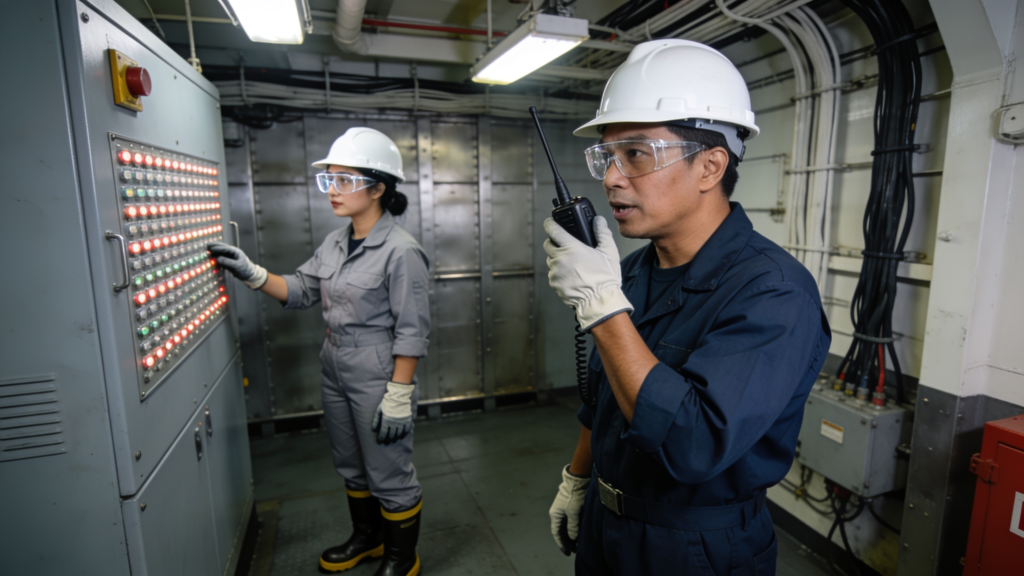
An inspector standing in front of a fire alarm panel forms a view in about fifteen seconds. What the panel is showing, and whether anyone on board can explain it, sets the tone for everything that follows in the inspection.
The FSS Code is prescriptive about this. A marine fire alarm panel has a defined set of conditions it must display and a defined set of places its alarms must reach, and a panel that cannot do both attracts a finding regardless of how well the detection loop performs.
Which Conditions Must The Panel Distinguish?
Five. Chapter 9 of the FSS Code requires the control panel to distinguish clearly between normal, alarm, acknowledged alarm, fault and silenced conditions. A fault signal must also be distinct from a fire signal, which rules out a shared indicator serving both purposes.
That distinction is the one most often lost on an ageing panel. A single amber lamp covering every abnormal state leaves the crew unable to say whether a section is faulty, disabled or simply silenced, and leaves an inspector with a question that the log then has to answer instead. The silenced condition deserves particular attention, because it is the state most easily misread. A silenced alarm is still an active alarm with its sounders muted, and a panel that displays it the same way as an acknowledged alarm invites a crew to assume the event has been dealt with. Where a replacement is being specified, a Tyco fire alarm control panel supplied from Singapore gives fleets trading through the Strait of Malacca a marine fire detection controller that presents those states the way the Code requires.
Where Do The Alarms Have To Sound?
At the panel first, and then through the ship. Activation of a detector or a manual call point initiates a visual and audible fire detection alarm signal at the control panel and at the indicating units.
If that alarm is not acknowledged within two minutes, an audible fire alarm must be sounded automatically throughout the crew accommodation and service spaces, control stations and machinery spaces of category A. The two-minute window is a design parameter and not a grace period, and a panel sited where nobody is stationed makes it meaningless in practice.
What Has To Be On The Navigation Bridge?
Indicating units must be sited on the navigation bridge. On passenger ships they must individually identify each detector that has been activated, which is the practical reason addressable systems became standard on that tonnage.
SOLAS Chapter II-2 adds a separate requirement for machinery space detection, where audible and visual alarms must be distinct from the alarms of any other system not indicating fire, provided in sufficient places to ensure that they are heard and observed on the navigating bridge and by a responsible engineer officer. Where the navigating bridge is unmanned, the alarm must sound in a place where a responsible member of the crew is on duty.
On passenger ships the control panel is additionally required to be designed on the fail-safe principle, so that a failure inside the panel presents itself as a fault rather than as silence. That principle is a useful test to apply to any panel under consideration, whatever the ship type, because a controller that can fail quietly is the one failure mode a detection system cannot absorb.
The choice between addressable vs conventional fire alarms turns largely on this point, since identifying an individual device at the panel is the capability an addressable loop buys. On a conventional installation the panel resolves to a section, and the crew resolves the rest on foot.
How Is The Panel Powered?
From two sources, one of which is an emergency source. The Code requires not less than two sources of power supply for the electrical equipment used in operating the system, with an automatic change-over switch situated in or adjacent to the control panel, and the emergency source must be sufficient to maintain operation of the system.
Testing that change-over is an annual item under the IMO maintenance guidance, and a panel that has never had it proven on board is a gap that surfaces quickly under questioning. Battery condition is the practical weak point behind it. A changeover that operates correctly on test but then supports the system for a fraction of the required period satisfies the annual item and defeats the purpose behind it, which is why battery capacity and age belong in the same record as the test result.
What Standards Is The Panel Approved Against?
The Code names them. The control panel is tested according to standards EN 54-2:1997, EN 54-4:1997 and IEC 60092-504:2001, and the current chapter text was introduced by resolution MSC.311(88) for ships constructed on or after 1 July 2012, with further amendments taking effect on 1 January 2026.
Checking the approval documentation against those references at the point of purchase is considerably quicker than discovering a mismatch at survey, particularly where a panel has been sourced as a functional equivalent to an obsolete model. Approval rests with the manufacturer, the class society and the flag administration, and a supplier’s catalogue entry is not a substitute for the certificate itself.
Compatibility is a separate exercise from approval, and both have to be settled before an order is placed. Confirming that the existing loop wiring, field devices and interface modules will work with a new controller is what determines whether a panel swap is a two-day job alongside or a rewiring package, and the answer changes the budget considerably.
Put A Panel On Board That Answers The Question
A controller that shows its condition plainly saves time at every inspection and every handover, and it removes an entire category of avoidable finding. Atlas Technologies Corporation is a Singapore-based supplier and an authorised distributor for Tyco, Federal Signal and Solo, supplying control panels, detection equipment and spares to fleet owners, technical superintendents and procurement teams across Singapore, Malaysia, Indonesia, Greece and Turkey. Speak to our team about what a replacement would involve on your vessels, and what the class and flag route looks like.