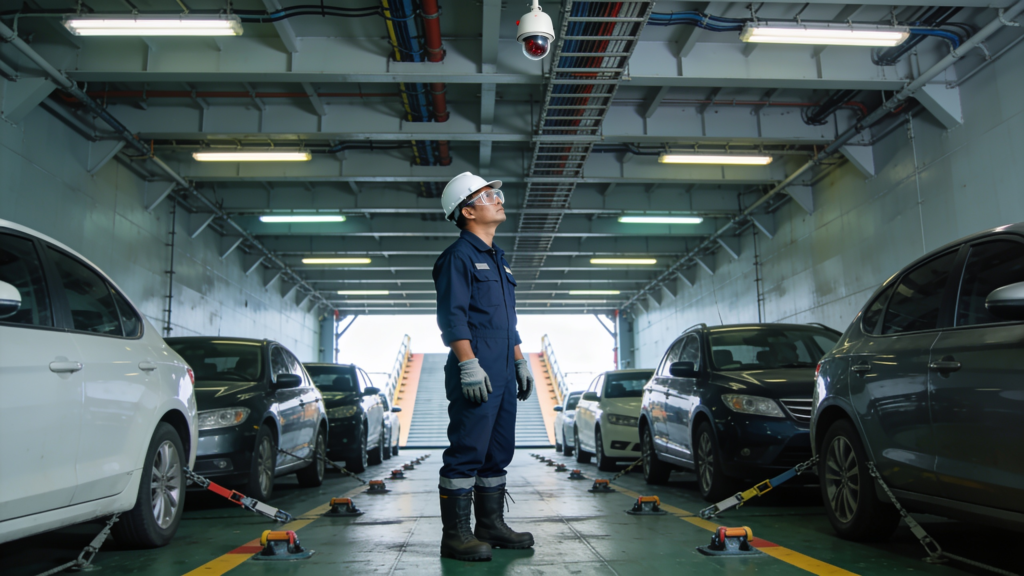
A superintendent who signed off on a car carrier’s detection layout in December 2025 would have found the same arrangement falling short a few weeks later. Amendments to SOLAS Chapter II-2 adopted under resolution MSC.550(108) entered into force on 1 January 2026, and they changed what a fixed fire detection and fire alarm system has to achieve in vehicle, special category and ro-ro spaces.
The changes are specific and measurable. They alter which detector technologies are acceptable, how far apart those detectors may sit, and what monitoring has to be provided alongside them. A separate compliance date applies to ships already in service, and that is where most of the planning effort now sits.
What Changed In SOLAS Chapter II-2 On 1 January 2026?
Resolution MSC.550(108) amended SOLAS Chapter II-2 and resolution MSC.555(108) amended Chapters 7 and 9 of the Fire Safety Systems (FSS) Code, both taking effect on 1 January 2026. The FSS Code is the technical standard that SOLAS refers to for the design and performance of fire safety systems, so an amendment there changes engineering specifications directly.
For vehicle, special category and ro-ro spaces, the headline change is that smoke detection on its own no longer satisfies the requirement. Heat detection must be provided in addition to smoke detection, or both functions must be combined within a single device. The regulatory summary published by ABS sets out the revised arrangements in full, including the fixed fire-fighting provisions that accompany them, and Lloyd’s Register has published its own class news on the same package.
Why Has Heat Detection Been Added Alongside Smoke?
Smoke detection responds early to smouldering combustion but performs unevenly in a large, heavily ventilated space where air movement dilutes smoke before it reaches a deckhead-mounted head. Heat detection reacts later to a smouldering source and far more predictably once flaming combustion is established.
Vehicle fires move through both regimes quickly, and a cargo deck packed with fuel, plastics and upholstery gives a fire a great deal to work with. Covering the two ends of that range is the reasoning behind the change.
Where a retrofit is being scoped, Tyco heat detectors held in Singapore give fleets trading through the Strait of Malacca a marine-rated option that can be specified against the new spacing figures without redesigning the loop from scratch.
How Close Together Do The Detectors Have To Be?
The amendments set maximum coverage areas and maximum spacing for each detector type used in these spaces. Getting the arithmetic right at the design stage avoids a difficult conversation at survey.
| Detector type | Maximum area per detector | Maximum spacing between centres | Maximum distance from bulkheads |
|---|---|---|---|
| Smoke detector | 74 m² | 11 m | 5.5 m |
| Heat detector | 37 m² | 9 m | 4.5 m |
| Combined smoke and heat detector | 74 m² | 9 m | 4.5 m |
| Linear heat detection cable | Not specified | 9 m | 4.5 m |
A unified interpretation approved at the 110th session of the Maritime Safety Committee confirmed two acceptable methods of calculating spacing for combined smoke and heat detectors in these spaces on passenger ships constructed on or after 1 January 2026, either a maximum of 9 m between detector centres or a maximum of 74 m² of deck area per detector. Choosing the method before the layout is drawn keeps the detector count defensible.
What Do The Video Monitoring Requirements Involve?
Video monitoring is now required in vehicle, special category and ro-ro spaces, with immediate playback so that the origin of an alarm can be established quickly. Cameras must be positioned high enough to see over stowed cargo and must cover the full extent of the space. Recordings are retained for at least seven days on ships constructed on or after 1 January 2026 and for at least 24 hours on ships already in service. Continuous crew monitoring of the feed is not required, so the manning implication is limited, although the recording and playback arrangements need to survive a power interruption in the same way the detection system does.
When Do Ships Already In Service Have To Comply?
Ships constructed on or after 1 January 2026 comply from delivery. Ships already in service have until the first survey on or after 1 January 2028, which leaves a defined planning window that most operators will want to align with a scheduled dry dock.
Detectors added under the amendments fall straight into the same fire detector testing intervals that govern the rest of the installed system, so the onboard maintenance plan, the test schedule and the spares holding all need revisiting once the new heads are commissioned. Treating the work as a detection project alone tends to leave those three loose ends.
Singapore-registered tonnage has a further reference point. MPA Shipping Circular No. 11 of 2025 brought a group of SOLAS amendments into national law with effect from 1 January 2026, including updates to fire detection and alarm requirements in accommodation, service and cargo control spaces.
What Is Still Being Developed For Electric Vehicles?
Measures aimed specifically at new-energy vehicles remain under development and are not yet in force. The IMO Sub-Committee on Ship Systems and Equipment is preparing interim guidelines on fire safety measures for pure car and truck carriers and on video monitoring and detection systems, with completion targeted for its thirteenth session in March 2027 and any consequential SOLAS amendments not expected before 2032, according to DNV’s report on the twelfth session.
Reading the 2026 amendments as the current obligation and the vehicle carrier work as a forward signal gives a fleet a sensible basis for capital planning, without committing budget to arrangements that have not yet been agreed.
Plan The Upgrade With Support That Knows The Rule Set
The compliance date for ships already in service is far enough away to plan properly and close enough that scoping should start now. Atlas Technologies Corporation is a Singapore-based supplier and an authorised distributor for Tyco, Federal Signal and Solo, working with fleet owners, technical superintendents and procurement teams across Singapore, Malaysia, Indonesia, Greece and Turkey. Speak to our team about scoping your vehicle space arrangements ahead of the next docking, and we will help you work through what the amendments ask of your particular hulls.