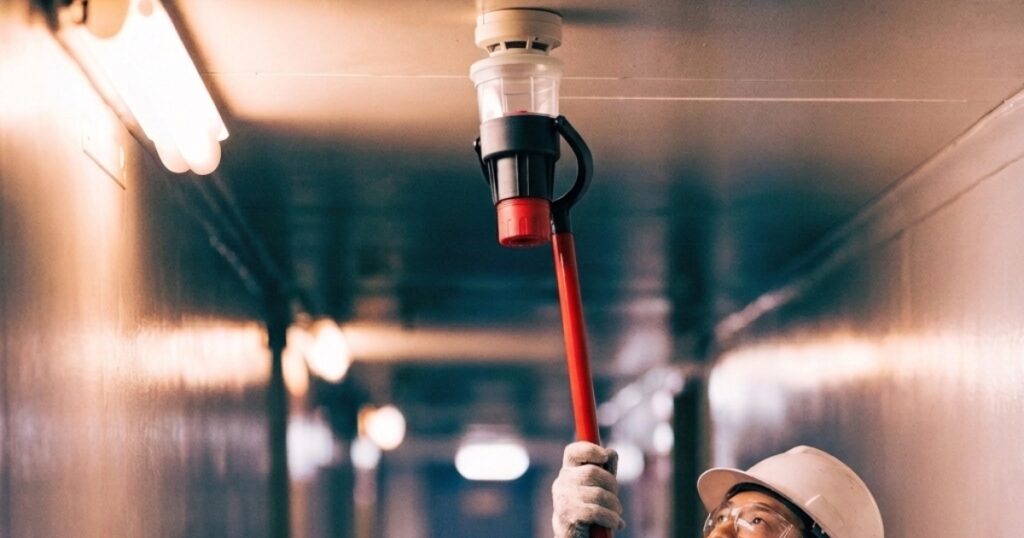
A boarding officer in Singapore who asks when a detector was last tested wants to see the record. The gap between a vessel that produces one immediately and a vessel that goes hunting for it usually predicts how the rest of the inspection will go.
Fire safety remains the largest single deficiency category in the region. The Tokyo MOU annual report for 2025 records 18,020 fire safety deficiencies out of 90,168 in total, close to a fifth of everything found across 35,546 inspections, with 1,255 ships detained. Detection systems account for a meaningful share of that, and almost all of it is preventable with a maintenance plan that is actually followed.
What Does SOLAS Require For Detector Maintenance?
SOLAS chapter II-2 regulation 14 requires that maintenance, testing and inspections be carried out based on guidelines developed by IMO, in a manner having due regard to ensuring the reliability of fire-fighting systems and appliances.
The maintenance plan has to be kept on board and made available for inspection whenever the Administration requires it. That plan must cover a defined list of systems, and fixed fire detection and fire alarm systems appear on it explicitly, alongside automatic sprinkler arrangements, fire doors, ventilation dampers and general emergency alarm systems.
The plan may be computer based, which is how most fleets now hold it. What regulation 14 does not do is state the intervals themselves; for those it points to IMO guidance.
What Are The Actual Testing Intervals?
The intervals come from MSC.1/Circ.1432, the revised guidelines for the maintenance and inspection of fire protection systems and appliances, which SOLAS regulation 14 points to. They have not changed for detection systems since 2012, because the 2015 amending circular revised the sprinkler and water quality provisions and left the fire detection paragraphs untouched.
| Interval | Requirement for fire detection and alarm systems |
| Weekly | Verify that all fire detection and fire alarm control panel indicators are functional by operating the lamp or indicator test switch |
| Monthly | Test a sample of detectors and manual call points, so that all devices have been tested within five years |
| Annually | Test all fire detection systems for proper operation; visually inspect all accessible detectors, so that all are inspected within twelve months; test emergency power supply switchover |
The five-year rolling requirement is the one that catches fleets out. A vessel that tests a handful of convenient detectors each month, always the same handful, satisfies the monthly line and fails the five-year one, and the shortfall only becomes visible when someone reconciles the test records against the detector schedule. Sample sizes on large installations may be agreed with the Administration or the recognised organisation. Keeping that rotation moving usually comes down to equipment, and solo detector testers are what make marine fire detection testing at height practical on a working ship; we supply them from Singapore for exactly this purpose.
How Should Detectors Actually Be Tested?
IMO sets the outcome, not the method. Neither the SOLAS regulation nor the guidelines prescribe a particular test apparatus, so the requirement is a performance one: prove that the detector responds and that the alarm reaches the panel, then restore the system. The FSS Code supports this by requiring that detectors can be tested for normal operation and restored to service without the renewal of any component, and manufacturers’ instructions fill in the method for a given detector type.
Applied properly, that means delivering the stimulus the detector is designed to sense, from the deck wherever the head can be reached with a pole. Removing the need for scaffolding or a ladder is what turns a rolling monthly sample into something a crew can complete between port calls. Combined units such as testifire generate more than one stimulus from a single head, which shortens the round considerably on installations carrying multi-sensor detectors.
Manual call points belong in the same rotation. Placement and device type of manual call points determine how each one is proven, and a resettable test key avoids breaking an element every time a call point is exercised.
Who Is Permitted To Carry Out The Work?
Competence is split, and the plan has to say where the line falls. MPA Shipping Circular No. 13 of 2021 requires owners and masters of Singapore-registered ships to apply the IMO maintenance guidance, and states that the onboard maintenance plan should clearly indicate which inspection and maintenance tasks may be performed by competent crew members and which are to be completed by persons specially trained. Work beyond crew competency goes to a competent shore maintenance specialist.
Why Records Decide The Outcome
The ISM Code turns all of this into an auditable obligation. Clause 10 requires companies to establish procedures identifying equipment and technical systems whose sudden operational failure may result in hazardous situations, and to provide specific measures promoting the reliability of that equipment, including regular testing of arrangements not in continuous use. A fire detection system is the textbook example, because its failure is latent and stays invisible until the day it is needed.
That is why an inspector asks for records before asking for a demonstration. A test log showing coverage advancing steadily across the detector schedule, with faults recorded against their causes and corrective actions, answers most of the question before the panel is touched.
Build A Testing Routine That Holds Up
Meeting these intervals is mostly a matter of having the right equipment on board and a schedule the crew can realistically keep. Atlas Technologies Corporation supplies test equipment, detection systems and spares to fleet owners, superintendents and procurement teams across Singapore and the wider region as an authorised distributor for Tyco, Federal Signal and Solo. Speak to our team about equipping your vessels for the rolling programme your maintenance plan already commits you to.