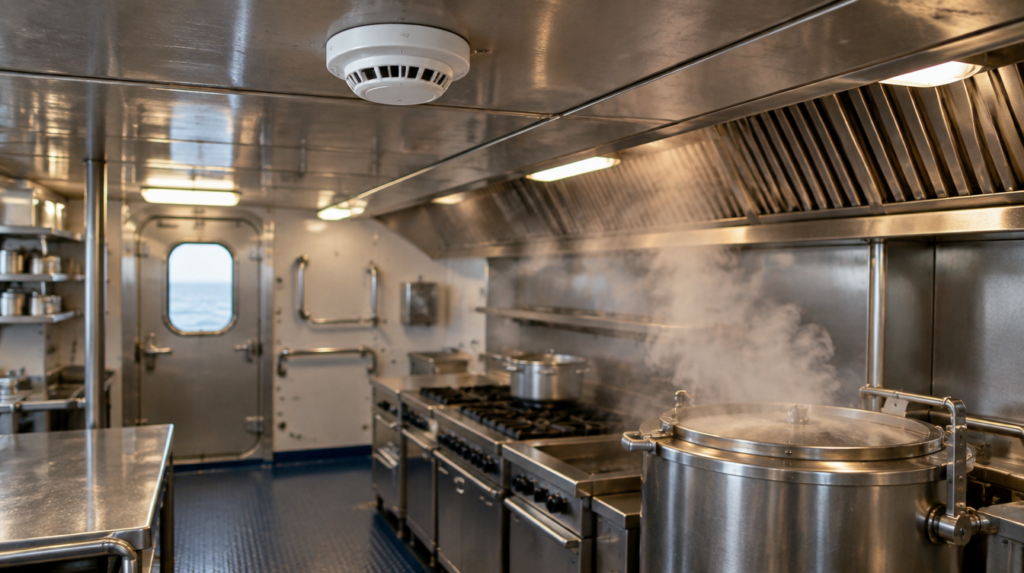
Nuisance alarms rarely come from across a whole vessel. They come from four or five compartments where the ordinary choice of detector was never going to survive the working conditions, and where nobody revisited the decision after the first month at sea.
The FSS Code leaves more room here than most specifications use. Detector technology is tied to space type in only one paragraph, and a second paragraph removes the obligation altogether for a defined list of low-risk compartments.
What Does The FSS Code Prescribe By Detector Type?
Very little. Chapter 9 states that detectors shall be operated by heat, smoke or other products of combustion, flame, or any combination of these factors, and then sets performance thresholds instead of space-by-space rules.
Smoke detectors required in stairways, corridors and escape routes within accommodation spaces are certified to operate before smoke density exceeds 12.5 per cent obscuration per metre. Heat detectors are certified to operate before the temperature exceeds 78°C, but not until it exceeds 54°C. Resolution MSC.311(88) replaced the chapter in its current form for ships constructed on or after 1 July 2012.
One further constraint applies across every space. All detectors must be of a type that can be tested for correct operation and restored to normal surveillance without the renewal of any component, which rules out any head that has to be sacrificed in order to prove that it works.
Where a like-for-like replacement is being specified, a Tyco smoke detector supplied from Singapore gives fleets trading through the Strait of Malacca a marine fire detection head that meets the obscuration threshold the Code sets, without a change to the loop it sits on.
Which Spaces May Use Heat Detection Instead?
The allowance is narrower than most people assume, and it is a permission, not a requirement. The Code states that where fire detectors are installed in freezers, drying rooms, saunas, parts of galleys used to heat food, laundries and other spaces where steam and fumes are produced, heat detectors may be used.
Note the scope of that wording. It covers the parts of a galley used to heat food, and not the galley as a whole, so a specification that swaps every galley head for a heat detector goes further than the Code contemplates.
Operating temperatures are allowed to rise with the space. Heat detectors in drying rooms and similar compartments of normally high ambient temperature may operate up to 130°C, and the amendments that took effect on 1 January 2026 under resolution MSC.555(108) added an allowance of up to 140°C in saunas, along with a testing reference for linear heat detectors.
Where Are Detectors Not Required At All?
Spaces having little or no fire risk need not be fitted with detectors, and the Code names them: void spaces with no storage of combustibles, private bathrooms, public toilets, fire-extinguishing medium storage rooms, cleaning gear lockers in which flammable liquids are not stowed, open deck spaces, and naturally ventilated enclosed promenades of little or no fire risk. Fitting heads into those compartments anyway adds devices to the monthly test rotation for no gain in protection, which becomes a slow and avoidable cost across a fleet.
The exemption is not a licence to leave a real risk uncovered. A void space used informally for stores stops qualifying the moment combustibles go into it, and the same applies to a locker that acquires a drum of solvent. Recording why a compartment was left without a detector, and revisiting that note when its use changes, is what makes the decision defensible at survey.
How Much Does Positioning Change The Outcome?
In many compartments it changes more than the sensing technology does. The Code requires detectors to be located for optimum performance, to avoid positions near beams and ventilation ducts or other positions where patterns of air flow could adversely affect performance, to avoid positions where impact or physical damage is likely, and to sit on the overhead at least 0.5 m away from bulkheads, except in corridors, lockers and stairways.
Spacing is tabulated, and the combined smoke and heat row was added by the 2026 amendments.
| Type of detector | Maximum floor area per detector | Maximum distance apart between centres | Maximum distance from bulkheads |
|---|---|---|---|
| Heat | 37 m² | 9 m | 4.5 m |
| Smoke | 74 m² | 11 m | 5.5 m |
| Combined smoke and heat | 74 m² | 9 m | 4.5 m |
Detectors in stairways are located at least at the top level of the stair and at every second level beneath. The Administration may also require or permit other spacing based upon test data demonstrating the characteristics of the detector, which is the route to take when a compartment genuinely does not fit the table.
What About Paint Lockers, Battery Rooms And Emergency Generator Spaces?
No IMO provision ties a detector technology to any of these. SOLAS Chapter II-2 addresses paint lockers through extinguishing arrangements and not through detection, and neither the FSS Code nor the class guidance reviewed here prescribes a sensing type for a battery room or an emergency generator space.
That leaves the decision with the specifier, working from the type approval, the ambient conditions and what the Administration will accept. Where a compartment has produced repeated nuisance alarms, the sensible sequence is to re-examine the space before re-examining the detector, since ventilation, head position and sensing technology can each be the cause. The walk-through that a marine fire safety audit forces is usually where the pattern first becomes visible, because it puts the alarm history and the physical arrangement side by side.
Match The Detector To The Compartment
A handful of correct decisions in the difficult spaces removes most of the false alarm load from a vessel, and with it the informal disablements that follow. Atlas Technologies Corporation is a Singapore-based supplier and an authorised distributor for Tyco, Federal Signal and Solo, supplying detection equipment and technical guidance to fleet owners, superintendents and procurement teams across Singapore, Malaysia, Indonesia, Greece and Turkey. Talk to our team about the compartments that keep raising alarms on your vessels, and we will help you work out what belongs there.