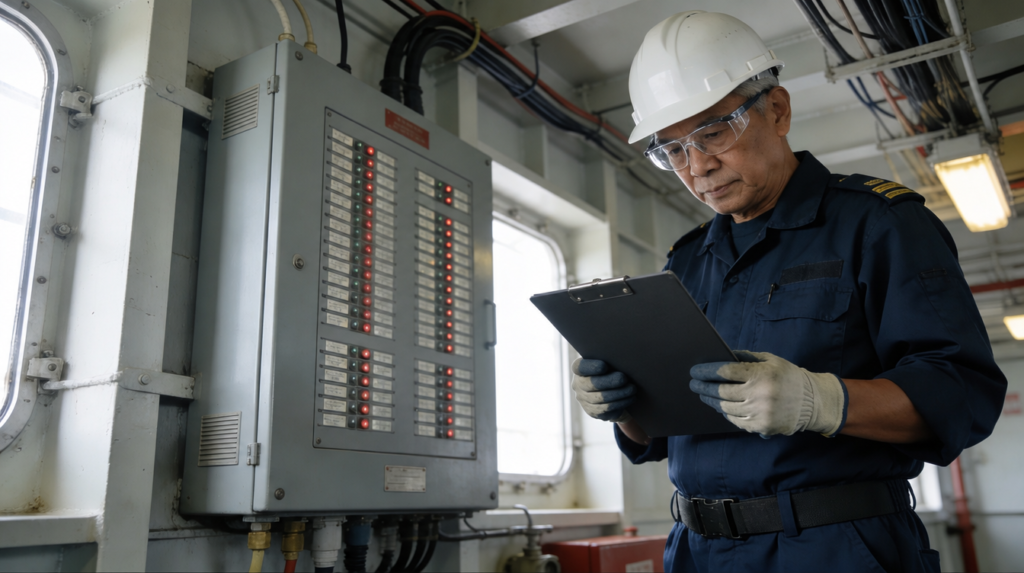
An inspector who boards at Singapore, Piraeus or Rotterdam will reach the fire alarm panel within the first half hour. Fire safety has held the top position in deficiency tables across the major port state control regimes for years, and the figures published for 2025 by both the Tokyo MOU and the Paris MoU show no sign of that changing.
For a technical superintendent the useful question is not whether fire safety attracts attention, but which specific findings keep recurring, and why so many of them are recorded against systems the crew believes to be working perfectly well.
How Often Does Fire Safety Appear In Port State Control Findings?
Fire safety measures accounted for 18,020 of the 90,168 deficiencies recorded across the Asia-Pacific region in 2025, close to one fifth of the total. The Tokyo MOU annual report for 2025 also records 35,546 inspections and 1,255 detentions, a detention rate of 3.53 per cent.
The European picture is similar in shape. Fire safety under SOLAS Chapter II-2 was the single largest deficiency category in the Paris MoU statistics for 2025, ahead of structural and electrical findings under Chapter II-1. Two independent regimes reaching the same conclusion is a reasonable signal that the pattern is real and not regional. For operators replacing equipment against a recorded finding, sourcing marine fire safety hardware from a Singapore base shortens the leg between the deficiency and the rectification.
Which Detection Defects Are Being Recorded?
Detection and alarm findings sit near the top of the detainable deficiency list, not merely the general one. The Tokyo MOU recorded 114 detainable cases against fire detection and alarm systems in 2025, behind fixed fire extinguishing installations at 215 cases and fire pumps and piping at 138.
The recurring items are rarely exotic. Detectors obstructed or painted over, heads left out of their bases after work in a compartment, loop faults standing on the panel, disablements nobody has cleared, and test records that do not reconcile with the maintenance plan all appear repeatedly. None of these requires the system to have failed, which is precisely why they survive on board unnoticed.
Chronic false alarms sit behind a surprising share of the findings. A section that produces nuisance alerts in a galley or a laundry gets disabled informally, the disablement outlives the person who made it, and an operational irritation ends up recorded as a fire detection deficiency. Correcting the detector selection for the space is the durable answer, since silencing the symptom leaves the finding available to the next inspector who reads the panel.
Why Does A Working System Still Attract A Finding?
A detection system can raise an alarm correctly and still attract a deficiency, because what is being assessed is the condition of the installation and the evidence behind it. A panel showing a standing fault is a finding whether or not the affected loop would detect a fire tomorrow morning.
Loop integrity is a common example. Where short-circuit isolators in marine fire detection loops have been bypassed during a repair and never reinstated, a single cable fault can disable far more of the loop than the design intended, and an inspector reading the panel event log will see the evidence of it.
Documentation accounts for a large share of the remainder. The onboard maintenance plan required under SOLAS Chapter II-2 Regulation 14 has to be kept on board and available for inspection, and it has to reconcile with what the logs show was carried out.
What Does An Inspector Ask To See First?
The panel and the paperwork, in that order. A clean panel with no standing faults, no disabled sections and a readable event log establishes credibility quickly, and a maintenance plan that matches the log entries usually closes the subject without further probing.
Crew familiarity is the third element, and it is assessed informally throughout. An officer who can explain what the panel is showing, which section covers which spaces and where the nearest manual call point sits will close a line of questioning that a hesitant answer would extend considerably.
Older tonnage carries an additional problem, since a legacy installation whose parts are no longer produced is difficult to rectify quickly. Atlas holds thorn security fire detection equipment precisely for that case, giving fleets running long-standing marine fire detection systems through the Strait of Malacca a route to a compatible replacement. Singapore-registered ships also work to MPA Shipping Circular No. 13 of 2021, which sets out how the maintenance, testing and inspection regime is to be implemented and who is expected to carry out each task.
How Do You Close The Gaps Before Arrival?
Five checks account for most of what inspectors record against detection systems, and all five can be completed on passage.
- Clear every standing fault and disablement on the panel, and record the reason and the date for anything that cannot be cleared before arrival.
- Walk the spaces and confirm that every detector is in its base, unobstructed and unpainted, particularly in compartments where recent work has taken place.
- Reconcile the test log against the onboard maintenance plan so that the two tell the same story.
- Confirm that changeover to the emergency source of power has been tested and recorded within the last twelve months.
- Check that the spares held on board match what the maintenance instructions call for, and order what is missing before the next port.
Make Readiness The Default Condition
A vessel that arrives with a clean panel and a reconciled log is not gambling on which inspector walks up the gangway. Atlas Technologies Corporation is a Singapore-based supplier and an authorised distributor for Tyco, Federal Signal and Solo, supporting fleet owners, superintendents and procurement teams across Singapore, Malaysia, Indonesia, Greece and Turkey with detection equipment, alarm panels, spares and technical guidance. Get in touch with our team to review what your fleet should be holding and replacing ahead of its next inspection cycle.