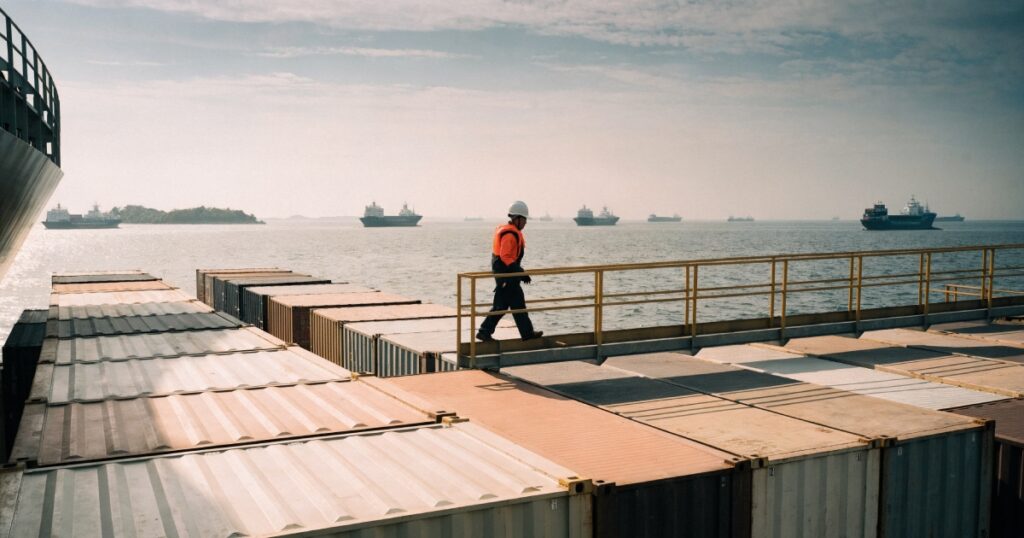
Smoke from a container stowed six tiers down has a long way to travel before anyone on the bridge knows about it. On most cargo ships it does not travel to a detector at all. The air is drawn out of the hold and carried to a detection cabinet somewhere else entirely, and everything about how quickly the alarm arrives depends on that pipework.
Sample extraction is a distinct regulatory system with its own chapter and its own failure modes. Treating it as a variant of ordinary detection is where most maintenance gaps begin.
What Is A Sample Extraction Smoke Detection System?
A sample extraction smoke detection system is a fixed installation that continuously draws air samples out of cargo spaces through a network of pipes and delivers them to a remote sensing unit, so that smoke is detected in the extracted air instead of by detectors mounted inside the space. The system comprises smoke accumulators, sampling pipes, three-way valves where it is interconnected with a fixed gas fire-extinguishing system, and a control panel.
The governing requirements sit in Chapter 10 of the FSS Code, which was replaced in its entirety by IMO resolution MSC.292(87) with effect from 1 January 2012. A good deal of secondary material still quotes the superseded 2000 text, so any specification or maintenance procedure written before that date should be checked against the current chapter. Atlas Technologies Corporation supplies detection equipment and spares for these installations from Singapore, as part of the wider marine fire safety range we hold for vessels and offshore units. That review often turns up a Tyco fire detection system panel that has outlived its documentation.
Which Cargo Spaces Have To Be Covered?
The obligation comes from more than one place, and the answer depends on what the ship carries. Under SOLAS chapter II-2 regulation 19, which governs the carriage of dangerous goods, ro-ro spaces must have a fixed fire detection and fire alarm system, while all other types of cargo space must have either a fixed fire detection and fire alarm system or a sample extraction smoke detection system complying with the FSS Code.
Regulation 19 also directs particular attention to paragraph 2.1.3 of Chapter 10, which requires the system to be designed, constructed and installed so as to prevent the leakage of any toxic or flammable substances or fire-extinguishing media into accommodation and service spaces, control stations or machinery spaces. That provision exists because the sampling network is frequently shared with the smothering pipework.
For passenger ships, regulation 7 requires a fixed fire detection and fire alarm system or a sample extraction smoke detection system in any cargo space that the Administration considers inaccessible. Closed ro-ro and vehicle spaces may use sample extraction as an alternative under regulation 20, though open ro-ro spaces, open vehicle spaces and special category spaces may not. Establishing which of these applies to a particular vessel, before ordering anything, saves a great deal of rework. The MPA marine fire detection guidelines set out how these obligations are examined in practice on ships trading through Singapore.
How Fast Must The System Raise An Alarm?
Chapter 10 sets the performance in seconds. An alarm must be received at the control unit in not more than 180 seconds for vehicle decks, and not more than 300 seconds for container and general cargo holds, after smoke is introduced at the most remote accumulator. Systems working on a sequential scanning principle may be accepted, with the maximum allowable interval capped at 120 seconds.
What Does The Installation Have To Include?
Several requirements in Chapter 10 exist specifically to keep the network working across a long service life, and they are the ones most often compromised by cargo operations:
- At least one smoke accumulator in every enclosed space for which smoke detection is required, positioned so that no part of the overhead deck area is more than 12 m horizontally from an accumulator, with a further accumulator in the upper part of each exhaust ventilation duct
- Sampling pipes of not less than 12 mm internal diameter, self-draining and protected from impact or damage during cargo working
- Accumulators from more than one enclosed space never connected to the same sampling pipe, so the location of a fire can be readily identified
- Means to monitor airflow in each sampling line, and duplicate sample extraction fans
- An arrangement for periodically purging the sampling pipes with compressed air
- A control panel that permits observation of smoke in the individual sampling pipes, sited on the navigation bridge or in the fire control station
The Code also requires that the system be of a type that can be tested for correct operation and restored to normal surveillance without the renewal of any component. A system that consumes a part every time it is proven will not be proven often.
Why Do These Systems Underperform On Large Ships?
Distance and dilution are the practical limitations. On a large container vessel the sample has to travel the full length of the pipe run before it reaches the sensing unit, and by the time enough smoke has accumulated in a very large hold to register at the far end of that run, the fire may be well developed. Powered ventilation compounds it, since regulation 19 also calls for at least six air changes per hour in spaces carrying dangerous goods, and air being changed is air being diluted before it is sampled.
The casualty record explains why regulators are revisiting the question. Allianz reported more than 200 fire incidents across the world fleet during 2025, the second highest annual total of the past decade.
IMO work at sub-committee level in March 2026 agreed draft amendments introducing portable infrared thermal imagers for screening containers, alongside updated functional requirements for water mist lances, with an expected entry into force of 1 January 2032. Nothing in that timetable helps a vessel trading this year, which leaves maintenance discipline as the lever available now.
Keeping The Network Proven
Sampling systems fail quietly. A blocked pipe, a fan that no longer draws, or an accumulator crushed during a loading operation produces no alarm at all, which is the one failure mode a crew cannot notice by watching the panel. Purging on schedule, checking airflow monitoring on every line and introducing smoke at the most remote accumulator during annual testing are what convert an installed system into a working one.
Atlas Technologies Corporation supports fleet owners, technical superintendents and procurement teams across Singapore, Malaysia, Indonesia, Greece and Turkey as an authorised distributor for Tyco, Federal Signal and Solo. Get in touch with our team to review your detection arrangement and source the certified replacement equipment your vessels should be carrying.