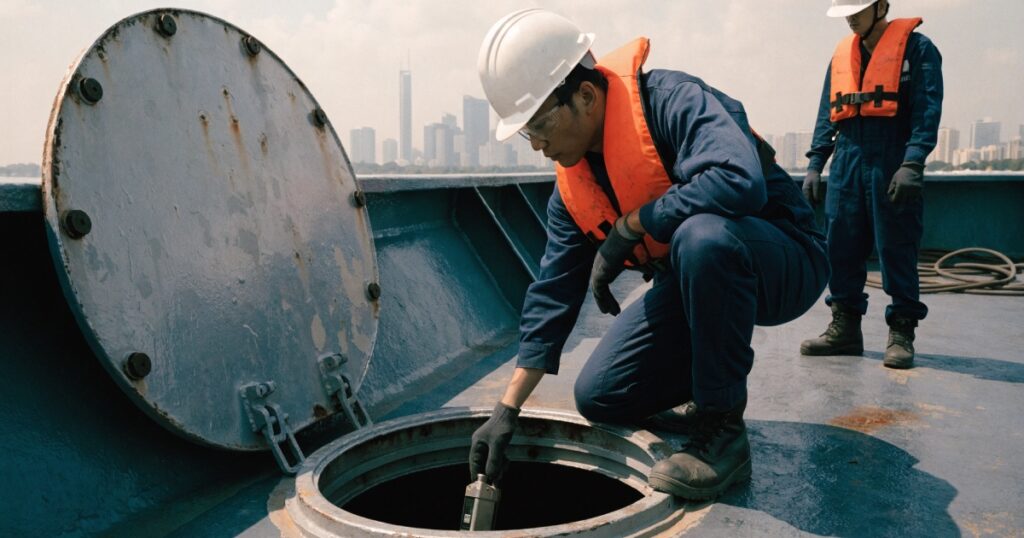
Two crew members are standing at an open hatch with a four-gas instrument that read clean five minutes ago. Whether that reading can be trusted depends on something done earlier in the week, and on whether anyone can tell the difference between the two checks that are supposed to have been done.
Bump testing and calibration are routinely spoken about as though they were the same task. They answer different questions, and confusing them leaves an instrument that reports numbers nobody has reason to believe.
What Is The Difference Between A Bump Test And A Calibration?
A bump test is a qualitative function check in which a challenge gas is passed over the sensor at a concentration and exposure time sufficient to activate all alarm settings, confirming that the sensors respond and the alarms operate. It does not adjust anything. A span calibration adjusts the instrument’s reading so that it coincides with a known, certified concentration of test gas, restoring measuring accuracy.
The distinction has a practical consequence. An instrument can pass a bump test while reading materially low, because the challenge gas was strong enough to trip the alarm even though the sensor has drifted. Occupational safety guidance from OSHA puts the sequence plainly: if an instrument fails a bump test or calibration check, carry out a full calibration before further use, and if it fails full calibration, remove it from service.
Keeping portable and fixed instruments in that condition sits within the wider marine fire and gas safety arrangements we support for vessels and offshore units working out of Singapore.
What Does SOLAS Require?
SOLAS chapter XI-1 regulation 7, adopted by resolution MSC.380(94) and in force since 1 July 2016, requires every ship to which chapter I applies to carry an appropriate portable atmosphere testing instrument or instruments. As a minimum, these must be capable of measuring concentrations of oxygen, flammable gases or vapours, hydrogen sulphide and carbon monoxide prior to entry into enclosed spaces, and suitable means shall be provided for the calibration of all such instruments.
Read that last clause carefully, because it is narrower than it is often assumed to be. SOLAS requires the means of calibration to exist on board. It does not set a calibration interval, and it says nothing at all about bump testing.
IMO’s supporting guidelines, MSC.1/Circ.1477, take the same approach. They require the instrument to perform a self-test on activation, state that manufacturers’ instructions should have clearly defined calibration requirements, and provide that where an instrument has an alarm or shutdown function triggered by an exceeded calibration interval, that function must not stop the instrument working during actual use. The interval itself is left to the manufacturer.
So How Often Should A Bump Test Be Done?
There is no IMO-mandated frequency, and any procedure citing one is not resting on SOLAS. The widely applied benchmark, a bump test or calibration check before each day’s use in accordance with the manufacturer’s instructions, comes from occupational safety guidance and from instrument manufacturers rather than from the Convention. For a working vessel that benchmark is sound, and building it into the permit-to-work routine is simpler than justifying a longer interval to an inspector.
What Changed With The New Enclosed Space Recommendations?
The recommendations most enclosed space procedures were written around have been replaced. Resolution MSC.581(110), adopted on 27 June 2025, sets out revised recommendations for entering enclosed spaces aboard ships, and IMO’s Assembly endorsed the revocation of the previous resolution A.1050(27) in December 2025. Procedures citing the old resolution number are now pointing at an instrument that has been withdrawn.
The acceptance criteria are where the change bites. The revised recommendations call for 20.9 per cent oxygen by volume, carbon dioxide below 0.5 per cent by volume, which is 5,000 parts per million, less than 1 per cent of the lower flammable limit on a suitably sensitive combustible gas indicator, and less than 50 per cent of the occupational exposure limit of any toxic vapours and gases. Testing must use properly calibrated equipment, follow manufacturers’ instructions, and be carried out before anyone enters and at regular intervals thereafter. None of that is new in principle, and the numbers are what a competent crew would already be working to, but the procedure on board has to cite the instrument that is actually current.
Compare that list against the four gases named in SOLAS XI-1/7 and a gap appears immediately. Carbon dioxide is not among them, so a compliant four-gas instrument carried purely to satisfy the SOLAS regulation cannot demonstrate the carbon dioxide criterion the revised recommendations set. Fleets that standardised their instruments years ago should check what those units actually measure before assuming the procedure is satisfied.
Where Do Fixed Systems Fit Alongside Portables?
Portable instruments answer a question at a point in time; fixed systems watch continuously. On tankers, offshore units and any installation handling hydrocarbons, fixed gas detection is generally interfaced with the fire alarm arrangement so that a gas alarm and a fire alarm reach the same manned position, and a Tyco fire detection system panel is commonly the point where both arrive. Fire detection technology on offshore platforms describes how those layers work together on installations where evacuation options are limited.
Neither layer removes the need to prove the other. Fixed sensors have their own bump test and calibration cycle set by the manufacturer, and IEC 60079-29-2 is the standard governing selection, installation, use and maintenance of detectors for flammable gases and oxygen where an explosive atmosphere may be present.
How Does Singapore Handle Gas-Free Inspection?
Operators calling at Singapore for repair work encounter a separate regime. MPA gas-free inspection applies to vessels carrying Class A or Class B petroleum before they enter a shipyard or repair facility, is carried out by MPA Port Chemists and certified by an Inspector of Petroleum, and requires fuel oil tank vapour to be at or below 50 per cent of the lower explosive limit. Instrument records tend to be examined as part of that process.
Get Your Instruments And Procedures Aligned
Atmosphere testing is one of the few areas where a small equipment gap translates directly into a serious personal risk, and the recent change to IMO’s recommendations makes this a sensible moment to re-read what your procedures actually say.
Atlas Technologies Corporation works with fleet owners, technical superintendents and procurement teams across the marine, offshore and oil and gas sectors as an authorised distributor for Tyco, Federal Signal and Solo. Contact our team to confirm what your instruments actually measure and to plan replacements against the requirements your vessels are held to.