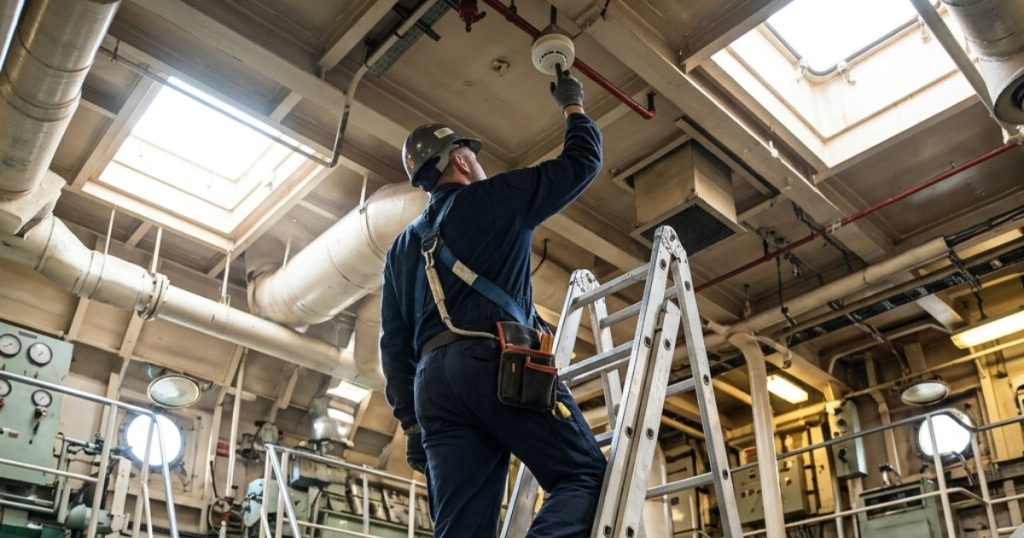
Every smoke and heat detector on a vessel has to be tested on a schedule, yet few people stop to think about how the engineer actually reaches the thing. Detectors sit on high ceilings, in stairwells and across cavernous cargo holds, often several metres above the deck. Getting up there safely, time after time, turns out to be one of the quiet challenges of keeping a ship compliant and ready for sea.
For decades, the answer was simple: grab a ladder and climb. The catch is that climbing adds a fresh risk every single time, and on a moving vessel, that risk only grows. A rising number of operators across Singapore, Greece, and Indonesia have switched to a safer approach, using extendable poles that let a technician test a detector from the deck. Understanding how the two methods compare can save you time and spare you a great deal of worry.
The Two Ways To Reach A Detector Overhead
Testing a detector means triggering it with smoke or heat and confirming the alarm responds as it should. To do that, someone has to get a test device right up to the sensor head. Two methods dominate the industry. The first is the traditional ladder or access platform, where the technician climbs up to the detector. The second uses a telescopic pole fitted with a test cup, operated from floor level.
Modern vessels rely on a range of sensors, and the spread of multi detectors in marine fire detection means even more units sit overhead waiting for a proper test. Both methods can do the job, yet they ask very different things of your crew and your testing schedule.
The True Cost Of Climbing A Ladder
Ladders feel cheap because the equipment itself is cheap. The true cost shows up elsewhere. Working at height is consistently one of the leading causes of serious injury in maritime and industrial settings, and a slip on a pitching deck or an oily engine-room floor can end a career. Beyond the human toll, an injured crew member in a remote offshore location can mean an emergency diversion, lost operating days, and an insurance claim that dwarfs the price of any test kit.
There is a practical drag, too. Setting up a ladder, securing it, climbing, testing, then moving it along to the next detector eats up time. On a vessel with dozens of detectors, those minutes stack into hours, and every extra hour spent in port or off-hire is money the operator never gets back.
How Solo Detector Poles Change The Job
Solo detector poles take the climb out of the equation entirely. The technician stays safely on the deck and raises a lightweight pole with a test cup on the end, delivering a measured dose of smoke or heat straight to the sensor head. Because the brand set the standard for this kind of equipment, many engineers simply call all such kits Solo poles, much the way people say they are hoovering rather than vacuuming.
A typical pole setup brings a few clear advantages:
- The technician stays on a stable surface, which removes the fall risk altogether.
- One person can cover a whole compartment quickly, with no ladder to reposition.
- The test cup holds the smoke or heat in place, giving a clean trigger and a clear pass or fail.
- Lighter kit means less fatigue across a long round of testing.
None of this asks the crew to learn a complicated new skill. Most engineers are comfortable with a pole within minutes, which makes the switch from ladders refreshingly painless.
What Safe-Reach Testing Looks Like In Practice
The clearest way to see the gap is to put the two methods side by side:
| Factor | Ladder method | Safe-reach pole |
| Fall risk | Present on every climb | Removed, feet stay on the deck |
| Speed per detector | Slower, with repeated setup | Faster, simply move and test |
| Crew required | Often two for safety cover | Usually one |
| Operational downtime | Higher | Lower |
| False-alarm control | Variable by operator | Contained, consistent dose |
A pole-based routine also suits how detectors are spread around a vessel. An engineer can work methodically along a passageway, testing each unit and logging the result, without the constant stop and start that ladder work forces on the job.
Less Downtime And Fewer False Alarms
The benefits land squarely on the pain points operators feel most keenly. False alarms, often caused by clumsy or inconsistent testing, fall away when a contained test cup delivers the same controlled dose to every detector. That consistency builds a crew’s trust in the system, so warnings are taken seriously.
A faster testing round means a vessel spends less time off-hire, something fleet managers in Singapore and Greece notice immediately when they are counting operating days. A method that keeps people off ladders also cuts the safety incidents that push up insurance premiums and create awkward conversations with auditors.
Compliance becomes simpler as well. Regulators expect detectors to be tested and the work to be properly recorded. A single engineer with a pole can move through a compartment steadily and document each result cleanly, which makes the paperwork as reliable as the test itself. For operators running tight schedules between ports in Singapore, Malaysia, and Turkey, that combination of speed and clean record-keeping removes a source of friction from every inspection cycle.
Reach Every Detector Safely With Atlas Technologies Corporation
Choosing how you reach your detectors shapes both the safety of your crew and the efficiency of every inspection. Atlas Technologies Corporation supplies trusted Solo testing equipment and the wider fire detection systems that operators across Singapore, Greece, and the region depend on to stay compliant and keep downtime low. Talk to the Atlas team today to find the safe-reach testing setup that suits your fleet and keeps your next inspection running smoothly.